

 30 Second Summary
Every year countless animals are exploited for tourist entertainment purposes - from circus acts and marine parks to elephant rides and fish pedicures. These attractions often rely on cruel training methods, captivity, and neglect, causing severe physical and psychological harm to animals. Our guide reveals the hidden suffering behind these popular holiday experiences and offers compassionate, cruelty-free alternatives like ethical wildlife tours and animal-free shows. Make your next holiday trip a kind one by choosing responsible and ethical tourist attractions.
Cruelty-free Holidays & Ethical Travel Guide
Summer is here! Great news for holiday goers seeking a well-deserved break. But not-so-great news for the thousands of animals enduring immense suffering for tourist entertainment.
The problem with using animals for entertainment is that in all cases, these animals will have either been taken out of their natural habitats or bred into unnatural, captive conditions for human profit. When we fund these attractions, we support practices that strip animals of their freedom and autonomy.
To help you plan a truly cruelty-free holiday, here are some common animal-exploiting activities to avoid and compassionate alternatives to consider next time you travel.
Riding Excursions

[Source: PETA UK]
As far back as history goes, humans have used animals to get about. But with modern alternatives available to us, riding animals is now merely a novelty - one that is frequently misused in tourism.
The animal most prevalently used is the elephant. Because of their size, sitting atop an elephant might seem harmless, but actually their bodies are not designed to carry any weight. Being forced to carry humans up to 8 hours a day with no rest leads to spinal deformities, pressure sores, cracked legs and arthritis, as well as foot rot and lesions from endlessly walking across uncomfortable terrain.
But the most horrifying part is that baby elephants are kidnapped from their mothers in the wild and undergo an awful breaking-in process, where they are restrained with ropes and cages, beaten using sticks and bullhooks, and tortured to the point of complete compliance. Obviously, early mortality rates are high, and those that survive have a lifespan half their natural length.
Camel rides in the Middle East, North Africa, and Asia are seen as a novel way to travel across deserts and beaches. But again, spinal deformities, pressure sores, and leg strain are common, and the animals spend most of their life tethered with minimal social interaction. Veterinary care in these countries is expensive, so any diseases or illnesses are left untreated. This renders the animal unprofitable, and so they are either killed or sold for cheap meat.
But one of the most gruelling animal rides still openly permitted is the use of donkeys and mules in Santorini, forced to carry tourists up and down over 500 steps along a 1,300-foot slope. In peak season, 2,000 donkeys are forced to work up to 20 hours a day. It is an exhausting feat in the blazing sun, with the animals starved to avoid them soiling on the track and walking a trail with no shade or water access. There are practically no regulations in place to protect them, and many bear open wounds, muzzles, and unnatural deformities. Owners have been seen beating them with sticks when they collapse, and when they become too sick or old, they are simply abandoned.
There is no ethical way to ride an animal on your holiday. Avoid these activities at all costs and instead visit ethical sanctuaries or non-invasive wildlife safaris to appreciate these animals in their natural habitats.
Marine Parks

[Source: Peter Phipp/Travelshots.com / Plant Based News]
Marine parks are hugely popular tourist attractions, with holiday goers eager to see our planet’s beautiful aquatic animals up close. Marine parks gained popularity in the mid-20th century after placing captured orcas, dolphins, and belugas into facilities across North America, Europe, and Asia and forcing them to perform tricks for audiences. But these conditions have catastrophic consequences.
Cetacean animals are highly intelligent, highly social creatures with complex emotional lives. They live in matriarchal communities and form lifelong attachments with one another, and have extensively developed brains similar to humans, meaning they experience a wide range of higher-functioning emotions such as empathy and grief. Forcing them into unnatural, isolated environments causes extreme signs of emotional distress, evidenced by unnatural behaviours such as banging their heads against walls, breaking their teeth on concrete and metal surfaces until their nerves are exposed, repetitively pacing, floating listlessly or lying on the floor of their tanks, and attacking trainers (previous to captivity, orcas have never exhibited violence towards humans).
The USDA Animal and Plant Health Inspection Service states that marine mammal pools only require a minimum horizontal dimension of twice the animal’s body length - a striking contrast to life in the wild where they can dive down 500 feet and swim up to 150 miles a day. This restrictive and mentally distressing environment results in captive cetaceans’ life expectancies being well below half of what they would be in the wild.
Despite numerous protests against marine parks like SeaWorld, and recent successes from PETA against Jet2holidays to stop selling tickets to marine parks, there are still hundreds in operation across numerous countries, including the USA, China, Japan, Spain, Argentina, and Ukraine, with an approximation of 3,600 cetaceans still held in captivity and forced to perform.
It is possible to find ethical ways to see marine animals in their natural habitats on holiday, with wildlife ocean safari tours, scuba diving, and conservation volunteering opportunities offering non-invasive and non-performative options. Just please remember to do your research beforehand to ensure they are eco-certified and operated by professional marine biologists.
Circuses
[Source: Four Paws]
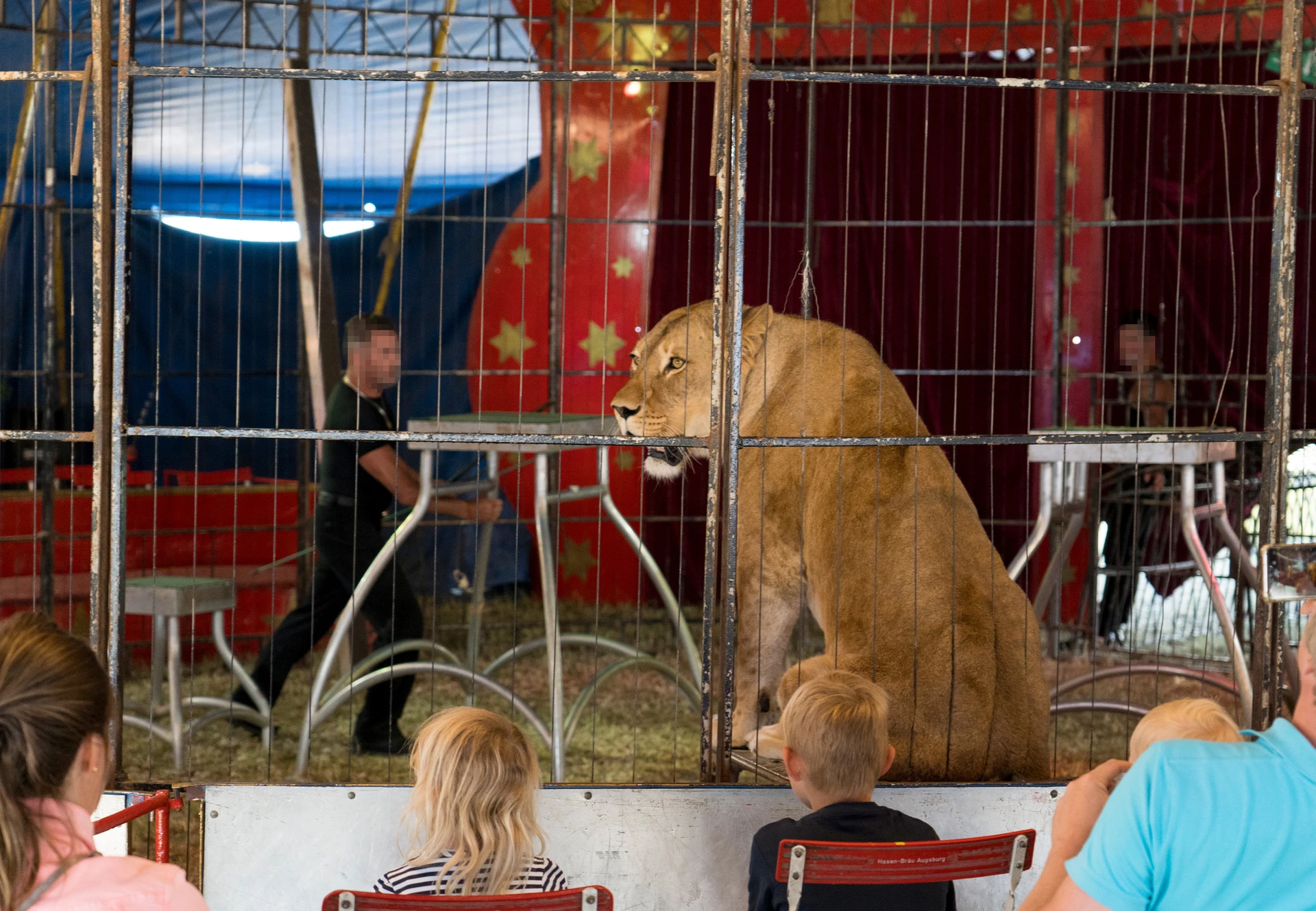
Circuses are renowned for their use of animals, with bears, big cats, elephants, and primates brought into the ring to perform stunts and tricks. But forcing animals into strict training rituals goes against their will and nature. Investigative studies reveal widespread use of fear-based behavioural conditioning, with bullhooks, whips, and electric prods used to scare them into performing. Behind the curtain, animals are kept in cages and chains, suffering physical and mental distress, and in some cases being fed drugs and alcohol to stay docile.
Thankfully, the use of animals in circuses is increasingly regarded as unacceptable, with at least 51 countries having banned or restricted the use of wild animals in circus acts. However, domesticated animals are not exempt, and there are no unified bans on animals being used in France, Germany, Italy, and Spain. Bears are also still frequently used in Russia and Eastern Europe.
While the Federal Animal Welfare Act in the US prohibits "cruelty", it is wildly unregulated, with “widespread acknowledgement by veterinarians, animal behaviour experts and governments… that the constant travelling and temporary accommodation will always compromise the wellbeing of animals in circuses.”
Moral responsibilities aside, attacks on trainers and audience members happen frequently, and many animals have escaped into populated towns and cities. There were 478 incidents in the EU over the last 24 years, with 13 fatalities and 99 people injured. 202 of those occurred in Germany, where the Federal Government still refuses to pass legislation banning the use of wild animals in circuses. PETA US has documented 20 fatalities and 144 injuries attributed to elephant rampages in North America, and several viral videos in Russia show bear attacks on trainers and audience members.
If you’re planning to visit the circus on your holiday, make sure to only attend animal-free performances such as Cirque du Soleil, where the only performers on the lineup are those who choose to be there!
Fish Pedicures

[Source: Viva]
Fish pedicures populate many tourist hotspots, with customers submerging their feet into tanks of water containing Garra rufa fish who nibble dead skin from the soles of their feet. They are presented as a cruelty-free spa treatment that the fish enjoy, but this couldn’t be further from the truth.
The Garra rufa fish are found in fast-flowing freshwater streams, so removing them en masse from these natural habitats can devastate surrounding ecosystems. When captured, they are dumped into still water tanks and can be transported hundreds of miles, resulting in extremely high mortality rates. Those that survive the journey are placed into overcrowded, unsanitary tanks, which cause further deaths from mishandling, stress, and poor water conditions.
Garra rufa fish are bottom-feeding grazers with a diet which includes algae, decaying plant matter, microorganisms, and aquatic insects and larvae. However, they are not fed any of this when used in fish pedicures, with the aim instead to starve them so they have nothing to eat but the dead skin from customers’ feet. This of course results in illnesses and early mortality rates.
Germany, France, Switzerland, and some US states and Canadian provinces have all banned the practices, primarily on the grounds of sanitary and health risks. But Turkey, where the idea originated, still makes wide use of fish pedicures, as do many other Asian and European countries.
If you want a pedicure, leave the animals out of it.
Want to learn more about the ways animals are mistreated by our society? Visit 3minutes.wtf and pledge to go vegan today.
Additional Resources:
Orcas don't do well in captivity. Here's why - National Geographic
How long do whales and dolphins live - PETA
Captivity - Whale Nation
Former SeaWorld Senior Orca Trainer Reveals the Terrible Toll Marine Parks Take on Animals - PETA
Doctor Fish Garra rufa: Health and Risk - IT Medical Team
Why We’ve Said ‘No’ To Elephant Riding - Rickshaw Travel
Camel Markets - Animals-Angels
