 30 Second Summary
We The Free’s Constellation Model of Leadership describes how volunteers, organizers, and the support team work together as an interconnected constellation. The model emphasizes local autonomy, shared responsibility, and community care, creating a structure that supports safety, consistency, and long-term growth.
At We The Free (WTF), we reimagine the traditional hierarchies of leadership. With a vast network of volunteers, organisers and employees, a familiar top down model has never really fitted our agenda.
Instead, we view ourselves more like a galaxy - mighty, interconnected, and radiant - with every star playing its part in the bigger picture. Which is why we’ve decided to adopt a fresh new leadership model to fit our evolution - which we’re calling the Constellation Model.
Why change from the “Inverted Pyramid” Model?
Since the founding days of WTF, our vision was one where local activist teams had autonomy to innovate, try new approaches, and make their own decisions. We conducted a ton of research into the most effective models, and found growing evidence that self-led, autonomous teams were outperforming more traditional hierarchical structures in productivity, satisfaction, innovation and resilience. We were also guided by results from the 2019 Animal Rights Survey in 2019 - the largest animal rights survey ever completed - where activists around the world said they lacked faith in organizational leadership and rejected the notion of movement figureheads telling them what to think, say and do.
The founding members of WTF never wanted the notoriety or authority of becoming traditional leaders. Instead, our ambition was to “work our socks off” in the background to support our growing network of inspirational activists, with job titles and responsibilities focused on “support” rather than “leadership”.
This is how we created the “Inverted Pyramid Model”.
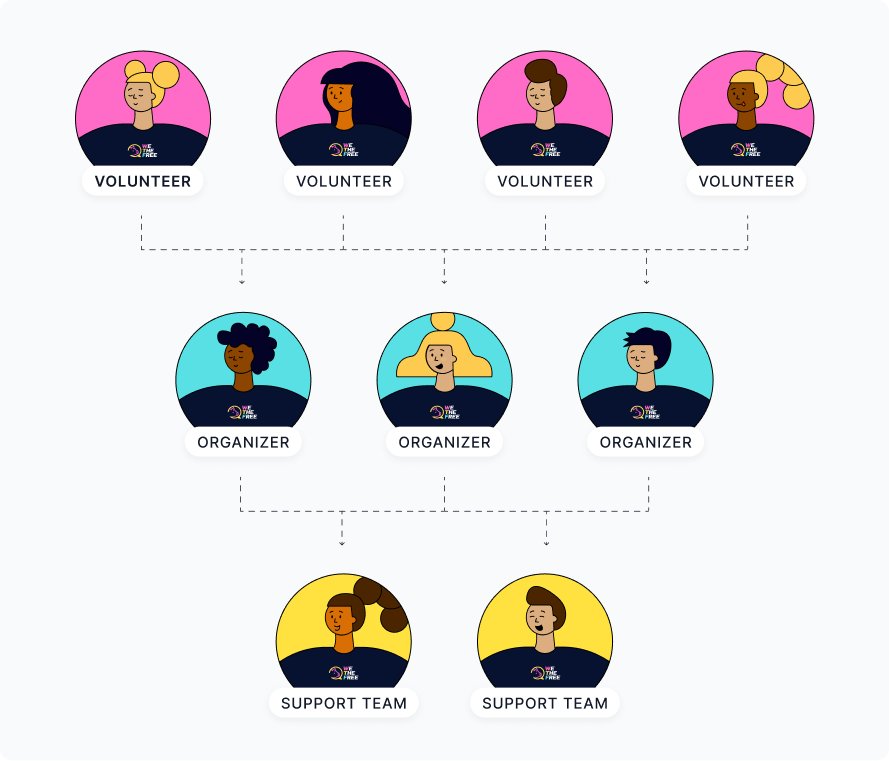
This model recognises that, without our volunteers, WTF simply could not exist. We encouraged local teams to follow our formula of autonomy, innovation and collective decision making while simultaneously collating surveys and feedback to inform, guide and adapt our strategy. This fair and diplomatic approach felt right. We knew that just because we founded the organisation, that didn’t mean we necessarily knew best, and consequently, many of our greatest initiatives have been developed through this
However, it hasn’t always worked. We once faced serious allegations about a volunteer, raising concerns for others’ safety. We handed the evidence to local organizers, who chose to give the volunteer another chance. This surprised our Global Support Team, given the severity of the accusations. Ultimately, we were forced to step in, recognising our duty to protect the community. In debrief, organizers admitted they had struggled to remain objective as they were too close to the conflict.
Essentially - we had identified an issue with our proposed model of leadership. We responded quickly by ensuring organisers completed more comprehensive training to appropriately fulfil their important role in our movement, and that any serious value breaches or community health issues would now require our involvement. Since then, things have certainly improved. Our regular Pulse Surveys indicate that volunteers feel cared about, supported, and any community health issues have been resolved effectively. Autonomy, innovation and collective decision making still guide our volunteer teams, with the Global Support Team always on hand for anything they might be needed for.
But another problem was rising. Where we were taking active measures to include our community in guiding the direction and strategy of WTF, not all voices were equal. It is often those with the strongest opinions who talk the loudest and are unwilling to compromise on their views. This can be challenging, especially when engaging online, and it didn’t seem right that less-active, opinionated and vocal community members held the same weight as those who had attended lots of events but maybe weren’t as assertive with their ideas and opinions. We believe that the major stakeholders in our movement are those who engage in learning and development, align with our values, consistently attend our events, and bring specialist skills and experience to their roles.
We also think it’s fair to acknowledge our Global Support Team, Board of Directors, and the Advisory Board, who have been employed as a result of their skills, expertise and experience in non-profit governance, investigations, conflict resolution, social change theory, research and academia, as well as investing in ongoing professional development within the animal right’s movement.
With this in mind, we are proposing a new model which combines our primary vision with the ongoing learning we have developed along the way.
The Constellation Model
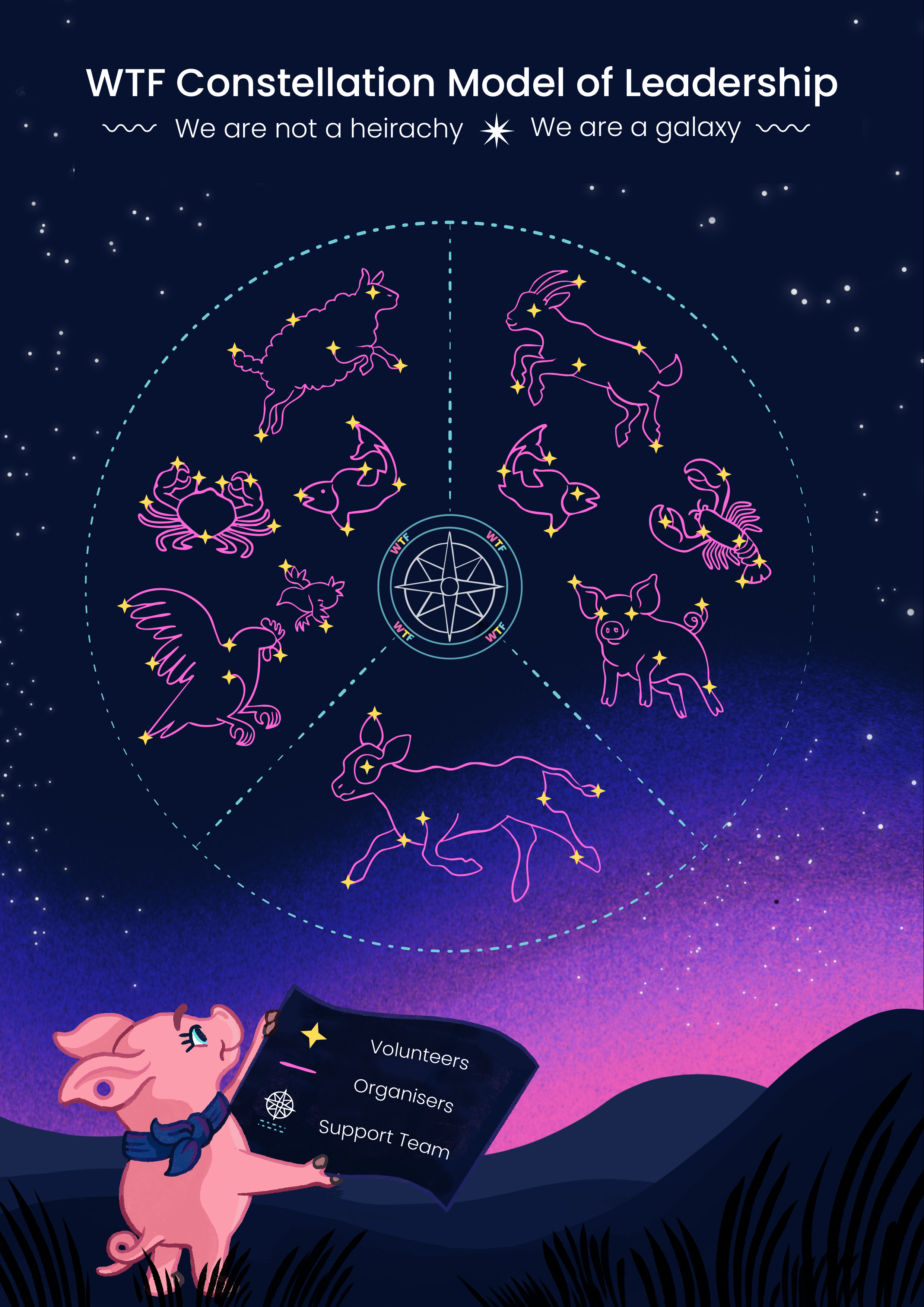
🌟 Volunteers – The Stars That Shine
Volunteers are the light of our movement. Every action, event, and conversation is sparked by individuals showing up with courage, compassion, and consistency. Volunteers are the stars of WTF - each one bringing a unique energy and radiance to our galaxy.
Volunteers have meaningful autonomy and are empowered to take action within the framework of WTF’s values, best practices, and messaging. While every volunteer matters, we recognize that deep commitment and long-term contribution carry greater weight. We honor those who give, grow, and stay aligned with our collective purpose.
🔗 Organizers – The Ones Who Connect and Guide
Organizers bring people together to form constellations. They give shape to local movements by building teams, coordinating actions, and nurturing a culture of support, safety, and accountability.
Organizers don’t lead through authority, but they are still leaders. They dedicate time, energy, and emotional labor, as well as undergoing training to develop their skills and make more informed decisions to help shape the direction of their team. Their position is one of relational leadership - supporting others to shine while holding the constellation together.
Their role is one of service, coordination, humility, and responsibility, and they deserve particular recognition and support for their work.
🧭 Support Team – The Compass for Navigation
The Support Team helps the movement stay oriented. We aren’t above or ahead, but instead sit in the center, supporting the wider network to stay aligned with WTF’s mission, values, and approach.
Our leadership is one of service and stewardship. We work with other stakeholders across the movement to understand how to adapt and grow while also staying grounded. We prefer not to issue orders, but instead utilise our experience and skill sets to contribute as and when it is needed. This could mean offering guidance, including others in decision making, facilitating dialogue, or supporting experimentation and innovation in new areas. We also listen, reflect, and respond so we can make informed decisions around strategy, ethics, and community safety.
Our aim is to create the conditions for others to thrive, and act as the compass which guides others to find their own way with clarity, compassion and confidence.
In Practice:
We will continue to seek ways of meaningfully engaging with our local teams and wider volunteer base by inviting them to engage in communal decision making where appropriate and practical. They will also continue to exercise autonomy within their teams, especially around operational decisions such as: how to run events, what event formats to prioritise, which footage to show (local, graphic, non-graphic etc.), or whether to collaborate with other campaigns. They will receive relevant training and feel empowered to deal with minor issues and conflicts at a local level, but with the security of knowing the Global Support Team is on hand for serious conflicts, such as values breaches and safety concerns, or any other issues, concerns or questions they may have.
We will continue to encourage teams and volunteers to innovate and try new approaches - with the support team providing assistance via resources, training, materials, guidance, and advice based on our experiences of best practice and the research available to us.
In addition to this, we now have the advantage of an experienced, resourceful, and carefully curated Global Support Team, whose expertise and contributions are deeply valued. We can pull from this vast resource of knowledge and apply those learnings as required. However, we will do this by maintaining and embracing a student mentality and seeking ongoing improvement, while also gathering feedback and data from our volunteer base to continue guiding our overall strategy and development.
We hope you can understand and appreciate this new model. It feels to us like an evolution of our previous model rather than a distinct change. It is there to provide safety, assurance, reliability, and union in our movement, and allow us to become the best activists we possibly can for the animals.
Thank you all for being a part of this scintillating galaxy.